




A Beauty Salon Where Women Can Remove Their Hijabs — Connections with Arab Women That Began Through Beauty —
2026/08/22
A hijab is a head covering worn by many Muslim women to cover their hair and neck.
It is often connected to Islamic faith and the idea of modesty.
Some Muslim women choose not to show their hair in front of men outside their family.
However, the way the hijab is worn—and the meaning it holds—varies greatly depending on the country, region, family, and, most importantly, the individual woman herself.
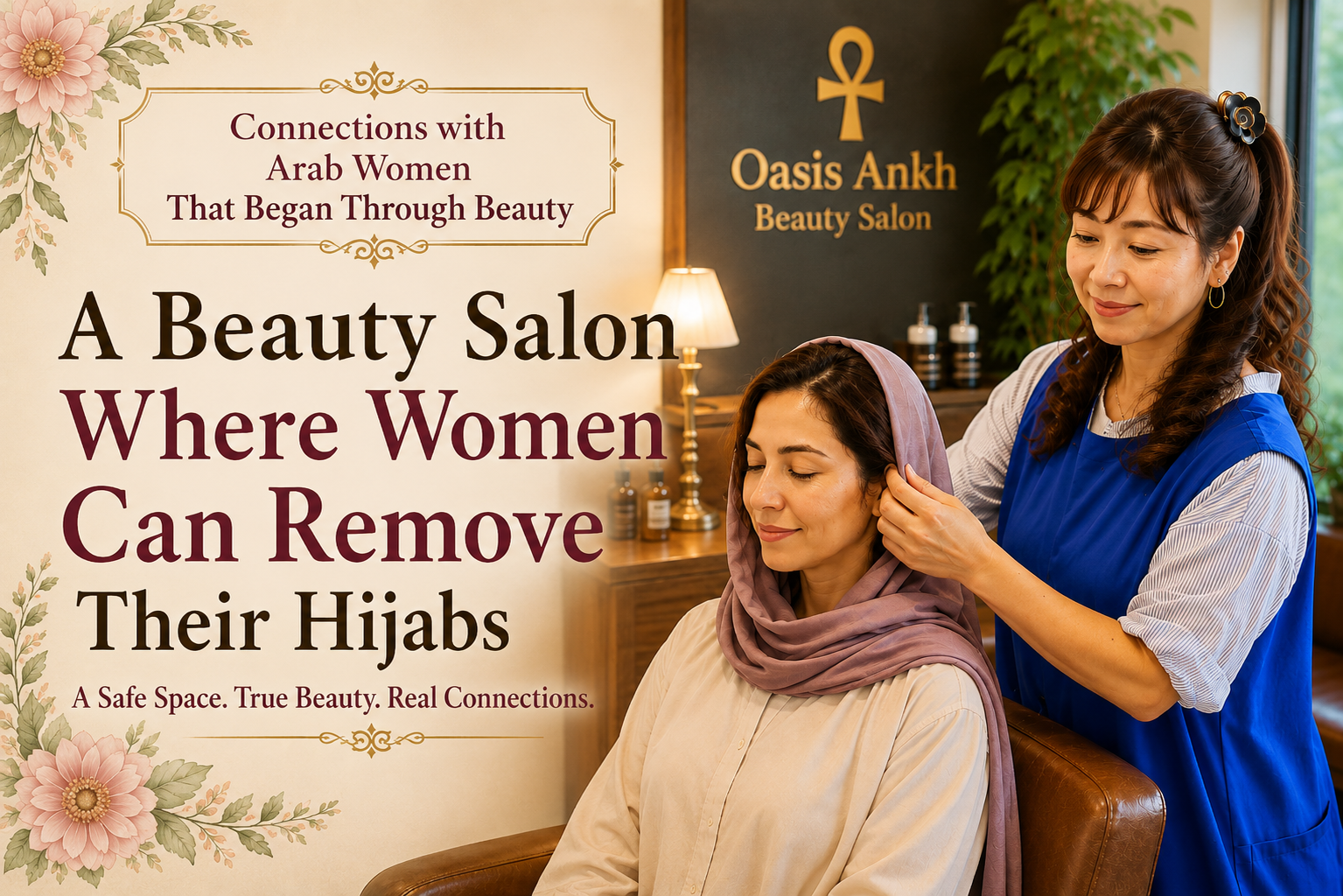
A Beauty Salon Where Women Can Remove Their Hijabs — Connections with Arab Women That Began Through Beauty —
Hello, everyone.
My name is Komina Obara, and I am a Total Balance Beauty Planner.
At my beauty salon, Oasis Ankh in Sapporo, Japan, women from Arab countries occasionally come to visit us.
Some of them are Muslim women who wear hijabs.
For women who wear the hijab, having a haircut or receiving hair care at a beauty salon can require considerations that may not usually occur to us in Japan.
They may need to make sure that their hair cannot be seen by men.
They may need to know that no men will enter the salon during their appointment.
And they may need privacy so that no one outside can see them while their hair is uncovered.
At Oasis Ankh, when necessary, we arrange appointments after regular business hours.
We lock the entrance door and lower all the window blinds to ensure complete privacy.
Then I tell them,
“It’s okay now. You can take off your hijab.”
And they do.
They show us the hair that they normally keep covered in public.
When I think about it, I realize that this is not something to take for granted.
They are placing a great deal of trust in us.
Arab Women from Hokkaido University Who Found Us Through Word of Mouth
I have always been fascinated by Arab culture, history, and especially ancient Egyptian civilization.
However, I never originally planned to create a “beauty salon for Arab women.”
I was simply thinking about the woman sitting in front of me:
“What can I do to help her feel comfortable and enjoy her time at the salon?”
The very first Arab woman who came to my salon was, if I remember correctly, an international student from Jordan.
It was about 20 years ago, when my salon was still located in a different, much smaller space nearby.
She had somehow heard that I was interested in ancient Egyptian civilization and Arab culture—I was also volunteering as a Japanese-language teacher at the time—and she reached out to me by email.
Little by little, these small efforts began to spread through word of mouth.
Over time, Arab women studying at Hokkaido University began visiting Oasis Ankh.
We speak different languages.
We may have different religions.
We grew up in different cultures.
And yet, when women sit down and talk with one another, we often discover how much we have in common.
We want to feel beautiful.
We want to live as ourselves.
We care deeply about our families.
We work hard in our careers and studies.
And we want to make our lives better.
Perhaps these feelings have no borders.
When Imane-san, a Former Hokkaido University Student, Worked at Oasis Ankh
Through these connections, Imane-san, a Moroccan woman who was studying at Hokkaido University at the time, once worked part-time at Oasis Ankh in public relations.
This was before the COVID-19 pandemic, so rather than working remotely, she came to the salon and worked in our office space.
Arab women were no longer only coming to the salon as clients.
We were also working together in the same place.
For me, this was an incredibly valuable experience.
Working together taught me that learning about another culture from books or the internet is very different from actually building relationships with people from that culture.
Things that seem completely normal to us in Japan may not be normal to someone from another country.
And, of course, the opposite is also true.
However when we work together,
eat together,
talk together,
and laugh together,
the difference between “Japanese” and “Moroccan” gradually becomes less important than the relationship between two individual human beings.
I believe this is what genuine intercultural exchange is really about.
Meeting Eman-chan from Egypt
Another person who has brought the Arab world much closer to me is Eman-chan, an Egyptian woman who is also studying at Hokkaido University.
Eman-chan and I talk about so many things—culture, family, women’s lives, work, and our dreams for the future.
Sometimes we begin with a very serious conversation and somehow end up laughing together.
She has even taught me how to make a delicious watermelon salad!
https://www.instagram.com/p/DNGRy4upvvr/?utm_source=ig_web_copy_link&igsi=MzRlODBiNWFlZA==
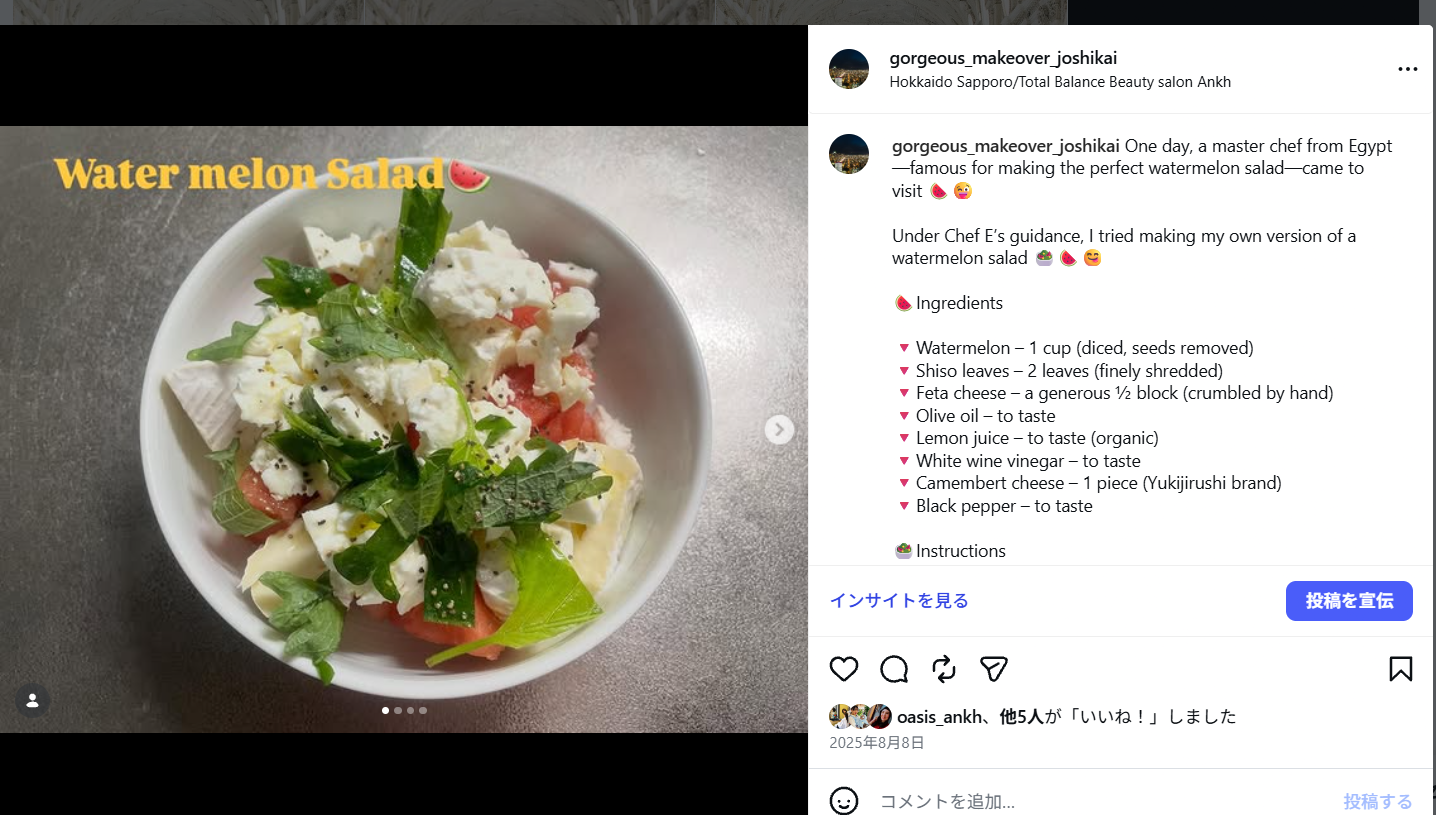
watermelon salad
The more time we spend together, the less I think of us as “a Japanese woman and an Egyptian woman.”
Instead, it simply feels like one woman talking with another woman.
Intercultural exchange is not only about discovering our differences.
Sometimes the most fascinating discovery is:
“We grew up in countries so far apart—and yet we are exactly the same in this way!”
I think those moments are one of the most beautiful parts of intercultural friendship.
What Hend-san from Syria Has Taught Me About Japan
Another woman who has taught me a great deal is Hend-san, who is originally from Syria.
Hend-san is currently conducting research as a visiting researcher at Hokkaido University.
She has lived in Japan for many years, and when I talk with her, she sometimes helps me recognize qualities of Japan that we Japanese people may no longer notice ourselves.
One thing she told me left a particularly strong impression on me.
It was about how some Syrian people see Japan.
For those of us who live in Japan, earthquakes are frightening, but they are also a familiar natural disaster.
People watching Japan from overseas, however, often pay attention not only to the disaster itself, but also to how Japanese people behave afterward and how society responds.
Sometimes people from outside a country can see qualities that those living inside it no longer notice.
When I talk with Hend, I sometimes find myself thinking,
“So that is how Japan looks from the outside.”
Hend-san once told me about a saying in Syria:
“Japan shakes the world, and earthquakes shake Japan.”
The expression reflects admiration for Japan’s strength and its ability to recover and rise again after facing great difficulties.
After World War II, Japan achieved remarkable economic reconstruction.
At the same time, Japan is a country that experiences frequent earthquakes, constantly reminding us of the enormous power of nature.
To me, the message behind this expression is about resilience:
No matter how many difficulties Japan faces, it rises again—and grows stronger through the process.
Our conversation happened around the time another major earthquake struck Kumamoto Prefecture, so her words touched me deeply.
Intercultural exchange is not only about learning about someone else’s country.
Sometimes, through another person’s eyes, we rediscover our own.
That is something Hend-san has taught me.
A Beauty Salon Is More Than a Place to Cut Hair
For many years, Oasis Ankh has valued an approach we call Total Balance Beauty.
It is not simply about making someone look beautiful on the outside.
It is about caring for the foundation of beauty—the hair, skin, and body—while also considering health, emotional well-being, and the way each person wants to live.
That is why I believe a beauty salon can play many different roles.
A place to cut your hair.
A place to become more beautiful.
A place to talk with someone.
A place to relax.
A place to encounter a culture you did not know before.
And sometimes, perhaps, it can become a place where someone feels:
“Here, I can relax and simply be myself.”
A Place Where I Can Say, “It’s Okay to Take Off Your Hijab”
It is evening at Oasis Ankh after regular business hours.
We lock the door.
We lower the blinds.
No men will enter.
No one outside can see inside.
And then I say,
“It’s okay now. You can take off your hijab.”
When I see a woman remove her hijab with a small expression of relief, I often find myself thinking:
Perhaps what we are providing is not only hair care or beauty treatments.
Creating a place where a woman feels safe enough to remove her hijab may also be one form of hospitality that we, as beauty professionals, can offer.
An International Exchange That Began with Small Acts of Consideration
Working together with Imane-san, who was once a student at Hokkaido University.
Sharing countless conversations with Eman-chan.
Learning about Syria—and even rediscovering Japan—through Hend-san.
And welcoming Arab women who come to Oasis Ankh after hearing about us through word of mouth.
Looking back, my journey into international exchange did not begin with a major event or an ambitious international project.
It began with one simple question about the woman in front of me:
“How can I help her feel safe, comfortable, and able to enjoy becoming beautiful?”
Locking the door.
Lowering the blinds.
Creating a time when no men will enter the salon.
These are very small things.
However from those small acts of consideration came conversations.
From conversations came trust.
From trust came friendships.
And now, those friendships are gradually growing into something new—connections between women in Japan and women from the Arab world.
I believe beauty has the power to bring people closer, even across cultural differences.
I hope Oasis Ankh will continue to be a place where women can feel safe and beautiful regardless of nationality or cultural background—a place where we can learn about one another, talk together, and laugh together.
And it all began in a small beauty salon where I could say:
“Here, you’re safe. It’s okay to take off your hijab.”
—
Information
WELCOME!
🧿 Arab × Japan Career Women’s Cultural Exchange
Where Matcha Meets Arabic Coffee ☕️🍵
If you are interested in our activities, please visit our social media pages below.
 Instagram
https://www.instagram.com/gorgeous_makeover_joshikai
 Facebook
https://www.facebook.com/sapporo.hairsalon.oasisankh
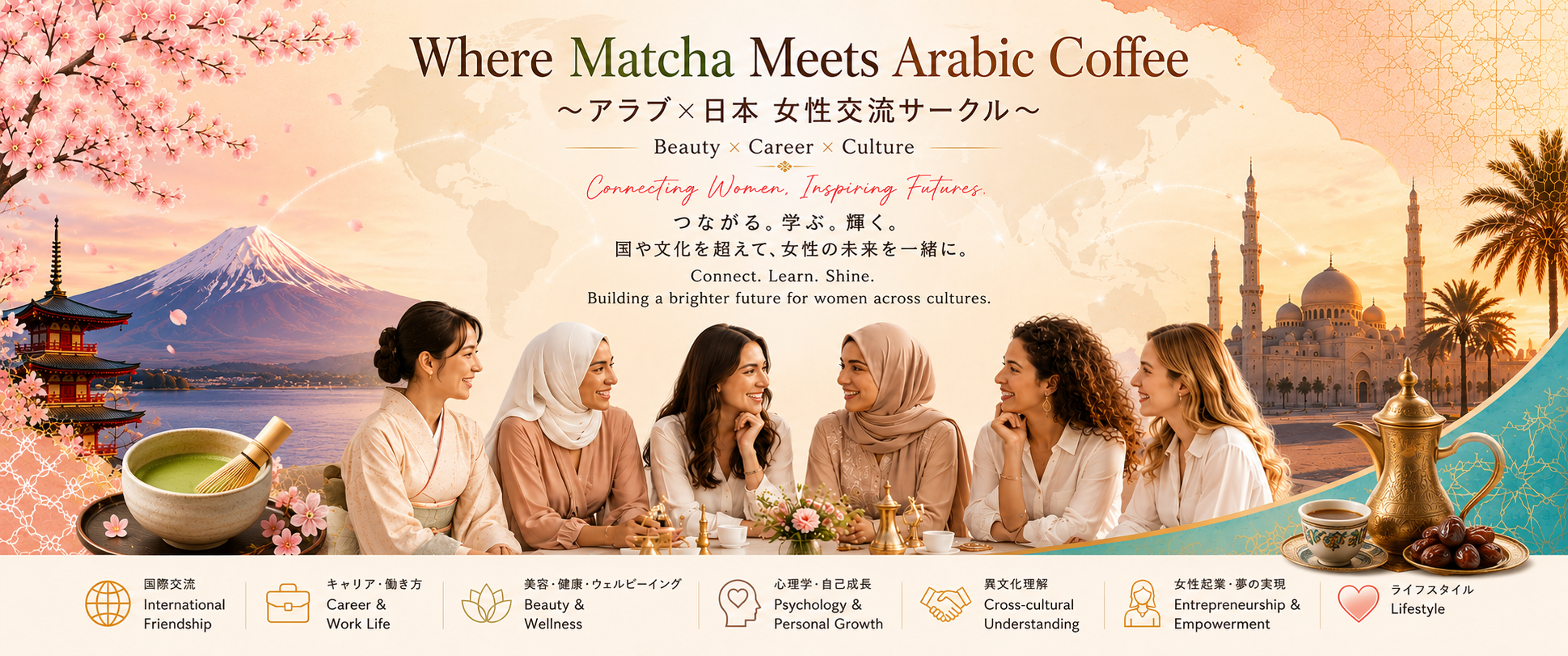
Where Matcha Meets Arabic Coffee ーA Beauty Salon Where Women Can Remove Their Hijabs — Connections with Arab Women That Began Through Beauty —
